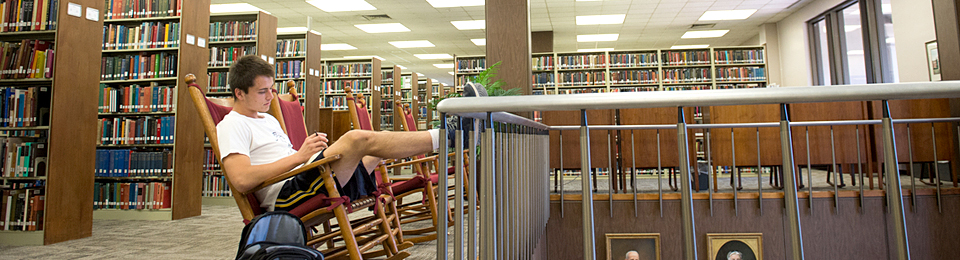
The Soundscape of a library is one that is encountered daily by most students at Davidson College and impact their study habits. In this project, I compare and contrast the different levels of of the library and how their different soundscapes came to be and what kind of environment this creates. I look at furniture layout, architectural design, and even how different purposes on different levels create positive feedback loops to help sustain the soundscape. The recordings show the different feelings created by different types of soundscapes which impacts the type of studying done in an environment, from relaxed to serious.
The Davidson soundscape is one that combines both natural, urban, and educational influences for the betterment of its students. While some soundscapes are simply a result of how a place took shape, something like a college has more intentional meaning behind the design of its spaces. For Davidson this is most evident in the Little Library, a space designed and regulated to have unique soundscapes on the different levels. While the entire building is meant to be a study space and a place for students to come when they need different resources, these amenities present themselves in a specific way on each floor.
To properly understand soundscapes and how I will talk about soundscapes, first I need to establish the terms I will be using to talk about it. In Schafer’s piece “The Soundscape” he identifies different types of sound. There is noise, which he defines as the sounds that have become such an integral part of the environment that they blend in and are mostly unnoticeable. There are keynotes which stand out and catch our attention. There are also signals which stand out like keynotes but also deliver information, such as an alarm or a ringtone. Lastly there are soundmarks, which like landmarks, we seek out or make for the purpose of listening to it. These are the terms I will be using to talk about the three levels of the library and how they sound.
The first floor of the library is almost contradictory in its sound. It is simultaneously a place where students flock everyday and yet despite the numbers, it is relatively quiet (at times). There is still plenty of noise on this floor. From the hushed conversations around the room, to the click clack of a computer, or the flipping of pages and pens, the room is full of sounds that have become part of the environment and become ignored unless you are aiming to listen to them. Occasionally a signal will pierce the calm but active soundscape of the room. This could be in the form of a computer alerting its user that it is low in battery or a phone letting someone know they are getting a call. These sounds are ones we are always ready to respond to. Even if it is not my phone ringing I may check to see if I have any notifications waiting for me on my phone. If I hear a computer saying it needs to be plugged in, then I will check to see how my computer is doing. As time passes when I sit in the library, I may occasionally hear a tour group come in. This sound is distant but is enough to make me more aware of my surroundings. It becomes a keynote in a way. Because it gets louder, I almost wake up from ignoring the sounds around me and suddenly become more aware of the presence of others. In most cases, these distractions would cause students, myself included, to listen to music. Having music available as a soundmark helps me to turn signals and keynotes into noise, or the sounds I have learned to ignore. Its almost like how stubbing your toe makes you forget all about how your hand hurts. Even if music isn’t perfect silence, it becomes the only thing I hear. All of these sounds can change. As the sound levels of the room ebb and flow, so too does the definition of these words. What normally might be noise in a louder environment can become a keynote in a quiet one. When the library becomes more still, even the scratching of pencil can be heard more clearly cutting through the silence, changing it from being a noise to a keynote that brings me back to awareness of the world.
While this soundscape is not all that unique, the reason it has come to be is. The reasons behind the manifestation of this has to do with the purposes of the space. First and foremost, it is a study space. This is why so many people come together and yet there is still almost a hushed vibe to it all. While it is quieter than most spots on campus, the first floor still has plenty of background sounds thanks to the set up and purpose. Beyond just being a study space, the first floor of the library is great for working in a group or with friends in a social environment. This is reflected in the furniture throughout the room. There are long tables that can accommodate large groups and loads of tables for smaller groups. Also, these places where people may study are not strictly separated. You can see clear across the room without any visual or auditory obstacles. What results is a more relaxed environment. The space is not so stressfully quiet that you can’t work but it also isn’t so loud that you routinely get distracted. It is for this reason that the space was designed like this.
The library’s second floor soundscape has some similar features to the first level. You can still hear faint conversations from the floor below, but they are more dampened. The sound of typing and pages turning is still apparent, even more so than on the first floor. When I am up there I can hear the sounds of lights humming and the AC working. Each cough, sneeze, and movement stands out far more than before. More than anything when I’m there, I become aware of my own sounds. I hear the typing, my breathing, and my shifting more so than before. It’s nice and its quiet but not unsettling. There’s enough background sound from the space around me that I can still settling into my own bubble.
The explanation for this floor’s soundscape is the same of the first floor in that is meant for a certain type of studying. On the second floor study spots are more isolated. While there are still tables for a couple of people, these are separated by bookshelves. This dampens the sound of the area and isolates each study spot. Also on this floor are study carrels, desks that while connected, have dividers between them. This creates more isolation allowing for more focused and individual studying. This individual studying also means there are less people on this floor. With less people, there is bound to be less noise as well. While the second floor is certainly much quieter than the first level, there is still plenty of ambient noise from people studying. They are focused on individual work but are not concerned with keeping the space silent. Part of the ambient sound comes from the design of the floor as well. The stairs walking up the second floor have a large opening that is connected to both the first floor and the entrance. On the other side of the floor is a balcony of sorts. It leaves a large open area in the ground connecting them to first floor. Both of these spots let sound trickle in from the floor below. It isn’t nearly as loud but the conversations and movement below is still heard on the second level. What this creates is a relaxed environment that allows for serious study. The people there can focus and do good work but still be surrounded by others and not feel alone in their work.
While the first and second floors have a feeling of focus without isolation, the basement is much different. Down there it feels as though there is nothing but me. All I hear is the faint sound of the AC through the walls. I cannot even tell if anyone else is down there. There is no typing, no pages, no scrawling of pens, just me. Each time I shift my weight I feel as though I am interrupting someone’s work. I try to calm my breath as to not disturb the silence. Even as someone walks by, it feels empty. Each clack of my keys sounds like the dropping of a shampoo bottle in a shower; loud and disruptive beyond what I thought it was capable of. I don’t want to adjust my position for fear of my backpack making a sound. I am legitimately worried about creating sounds.
The earie feeling of being in the library’s basement is again created by the intended purpose of the library. The basement has strict rules when it comes to sound. You are supposed to be quiet. Not just trying to keep it down but being near silent. No music, no talking, and nothing disruptive is allowed don’t there. The unsettling feeling created is compounded by the structure and design of the basement. The ceilings down there are much lower than the rest of the library. Along with this, the entrance to the basement is entirely sealed off. There is a glass wall and thick door to ensure no sounds from upstairs will disturb people working. The layout is similar to the second floor with tall bookshelves blocking off the study spaces so that no interaction between students is even feasible. What this environment creates is a place that alerts you to any amount of sound at all. Any motion or presence can be detected almost immediately. It also causes people to want to be quieter. When people hear themselves move because of how quiet it is, it prompts them to remain quieter and thus creates a positive feedback loop.
These three study spaces are each designed to manipulate their soundscapes for the benefit of the type of work that occurs in each space. While on the first floor there is more open space for conversing, on the second flood there is more separation between students, and in the basement floor there is total isolation.
- Schafer, R. Murray. “The Soundscape,” in The Sound Studies Reader, edited by Jonathan Sterne, 95–103. New York: Routledge, 2012.
- “TEDTalks: David Byrne–How Architecture Helped Music Evolve.” Performance by David Byrne, TEDTalks: How Architecture Helped Music Evolve, TEDTalks, 2010.
