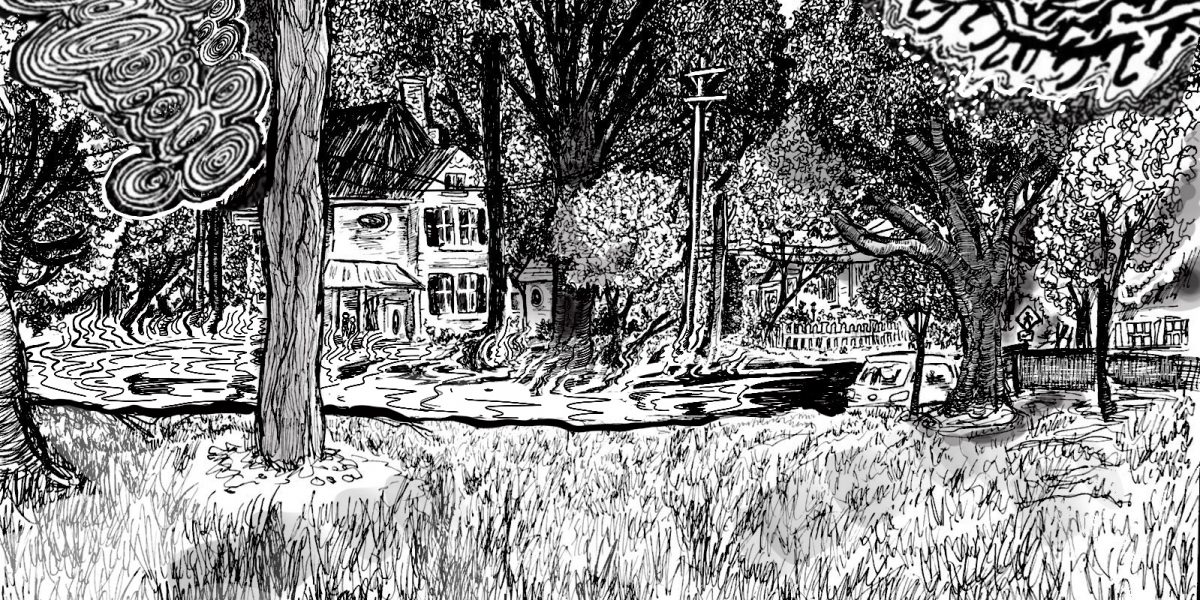
On August 15th 2019, I took a flight from John F. Kennedy International Airport to the Charlotte Douglass International Airport. I soon learned that when flying halfway across the country, temperature and culture are not the only changes as for the atmosphere. In coming to the South, I found myself in a not only a new environment but a new soundscape entirely. Suddenly, I had experienced what I would later label as a multiplex consciousness, as stated by DJ Spooky, but at the time was nothing more than the realization of my other-ness. In New York, my voice and the sounds I was so accustomed to were a part of everyday life, whereas in Davidson, they had become a piece of my identity. For the first time, my identity wasn’t reflected by the surroundings, but rather the surroundings had become my identity. My identity had become more nomadic, and evolved into a product of the settings, Northern and Southern, that I had been immersed in. At the time, this understanding of my sonic relationship between myself and the new setting of Davidson was one of assimilating to a foreign environment, a product composed solely of accents and exclusively stereotypical “northern” or “southern” sounds.
New York had always been a setting and surrounding. However, with the abrupt change of living my whole life in New York to suddenly moving into a dormitory in North Carolina, what had once been external noise had now become an internal part of identity. Without having any prior knowledge of the relationships between voice, noise, and sound or any of the vocabulary and tools to analyze them, this transition was anything but smooth. As a result of general ignorance as for how sound affected my identity, I categorized the two “factors of my identity” into the most stereotypical images of regional noise. The first of the two was the external part of my identity, my accent. My knowledge of my accent at the time was limited to describing it as fast paced and pronouncing “o” as “aw”. In the audio file below, you can hear two New York natives speaking (rather comically) in a slightly exaggerated accent from my hometown. Without any knowledge of DJ Spooky’s “multiplex consciousness” or Rhythm Science, I couldn’t explore the reasons, causes, or effects of my accent being my external mask to everyone; and as a result, my identity was the “kid from New York”. Additionally, without having ever read the works of Schafer and his “soundscapes”, I was unequipped to answer the many questions I had regarding the sound of the environment around me. Like the accents, the soundscapes of Astoria, Queens and Davidson, North Carolina are nothing short of different worlds. The contrast between the whizzing of vehicles on crowded corners or the roar of subway carts flying by and the peaceful hymn of cicadas is overwhelming. However, at the time these sounds were just a part of life, not an identity or soundscape; they were broken into their simplest form: a plethora of different pitched noises culminating to make a metallic or motorized noise that told me to stand clear of the tracks.
On January 14th, I began my first day of exploring sound within my writing course. Through exploring the noise around me, I was able to reevaluate and analyze my own identity in this environment, now equipped with the teachings of Aristotle, Schafer, Paul Miller, etc. Within my third writing project I analyzed the soundscape produced by my surroundings, and how these sounds influenced my thinking and listening. Interestingly, my identity can be portrayed as a bias in this project as my goal was to express how natural sounds aren’t always pleasant, and artificial or more urban sounds can also be pleasant; as seen in this excerpt from analyzing the sound of cicadas in Davidson. This preference for urban sounds such as those that I believed comprised my identity can be seen here: “… on any given night above sixty degrees without rain, the unmistakable call of cicadas drowns out just about any other noise. The incessant ringing is reminiscent of a broken air conditioner. In Michael Chion’s The Three Listening Modes he mentions three forms of listening of which one is particularly useful for observing these sounds in nature. Via “Reduced Listening”, we can listen to a recording of the cicadas as opposed to being in the presence of the sound, and the sound itself becomes much clearer and loses the natural and peaceful aspect of the soundscape. Instead of looking for the cause of the sound, such as in casual listening; we entirely disregard the cause and associations that come with it, leaving nothing but the sound itself and its individual soundscape. Upon listening to the recording below, the noise emitted is more reminiscent of the static from a television rather than any insect. While the individual might hear many different varying sounds, there is a common unpleasantness to the constant high-pitched, monotone ringing.”
Towards the end of the semester, once my accent from winter break had fully reverted to the indistinguishable mid-Atlantic accent and I had resettled into the campus setting; I noticed my identity changed with it. Within the town of Davidson, the accents are indistinguishable, and the sounds aren’t necessarily suburban or urban. In one reduced listening exercise, I went to Raeford’s Barber Shop, and they allowed me to record an average day in the town. As I listen to the buzz of the razor and cars in the background, coupled with the small talk of the customers; I no longer viewed myself as the outsider. Like everyone within the Davidson Community, I was a Davidson student from a different hometown, not a New Yorker in Davidson. I had noticed a similar feeling as to when I was originally in New York: my accent wasn’t distinct, and my surroundings were a soundscape, but also a small part of my identity as a Davidson student. I had finally experienced my own multiplex consciousness.
Throughout the spring semester and my writing course, I learned how to accurately and articulately analyze my own relationship between my identity and the sonic world around me. Additionally, as I grew more comfortable and figured my own place within my new environment, my role in listening to my surroundings had changed. I was no longer the outsider of the Davidson soundscape; I was an integral piece of it. This allowed me to entirely change how I listen to and assess the sounds of Davidson itself as both a town and a conceptual representation of both college campuses and North Carolina. Through exploring the intricate relationships between voice, noise, sound, and identity, I no longer experience the sonic world I live in as a foreign binary opposition of my identity being the north and my environment being the south; but rather my identity and surroundings being a culmination of both. That is the idea of multiplex consciousness to me, the concept that there is no monolithic sound in identity; all identities and sounds are a melting pot of different influences and factors that result in a distinct blend of noise. What made the sounds and voice of identity and my environment different and unique was not their specificity and originality, but their recycling, remixing, and revising of the sonic factors around them.
Bibliography:
“Aristotle on Voice.” The Complete Works of Aristotle, by Aristotle, Princeton Univ. Press, 1995, pp. 667– 670.
Chion, Michael. “Michael Chion 3 Modes of Listening.” Artcites.uscs.edu.
http://artsites.ucsc.edu/faculty/gustafson/FILM20P.W11/readings/chion.3modes.pdf
Kaplan, Matthew. “The Natural Sound of the Unnatural .” WRI-101: VOICE, NOISE, SOUND, SENSE., 15 Apr. 2019, www.wri-101k-s19.andrewrippeon.com/blog/category/writing-project-3-the-davidson-soundscape/.
Miller, Paul aka DJ Spooky That Subliminal Kid. Rhythm Science. MIT Press: Mediawork, 2004.
Schafer, R. Murray. “The Soundscape.” The Sound Studies Reader, by Jonathan Sterne, Routledge, 2012, pp. 95–103.