Imagery enlivens and enlightens my surroundings. In kindergarten, I was obsessed with a phonetic sound book with buttons embedded into the pages that would light up with different colors dependent on the letter on the page above. I distinctly remember the “z” page containing a purple button, and the letter “c” accompanied by red. Now, when I travel on airplanes, I have made it a habit to listen to music and imagine appropriate music videos or visuals. Visuals, whether imagined by the audience or intentionally presented by the artist, do not necessarily change the meaning of the voice or what is being said, but help to clarify it. It is unfair to view these different sensory features as separate or opposing approaches. Instead, they exist in a unified and mutualistic symbiosis. In this class, we were encouraged to examine the implications of voice, noise, and sound. Most importantly to me, though, the class also underwent a thorough investigation of “sense”.
The visual dubbing in Bad Lip Reading transformed bizarre sentences into humorous yet believable caricatures. Iggy Azalea’s reinvention of her identity was detailed in her music and visually displayed in her music videos. Hiwa K’s This Lemon Tastes of Apple was an audio-visual presentation, where the audio of the harmonica being played and the shouting protestors was amplified and accompanied by the video of those marching demonstrators. Hiwa K recognizes the importance of the combination of these two sensory approaches. He does not need to translate the voices of the Kurdish protesters, because “the work brings through the image and the music the atmosphere of the momentum”(Szylak, This Lemon Tastes of Apple Description). These examinations demonstrated the ways in which visuals were integrated with sound to elaborate upon the tonality and substance of the creation. More subtly, the imagery evoked in Jordan Scott’s blert was a useful tool in drawing meaning from seemingly nonsensical phrases, and DJ Spooky the Subliminal Kid’s Rhythm Science used visual art to re-address and re-contextualize his terminology of sound within a broader, multi-sensory context. I wrote about the importance of imagery in my essay Truth Outside of Reality. Danez Smith delivers their poetry with a voice full of potent visuals and their physical expression becomes inseparable from the words inside the poem.
“Smith’s focus on passion and expression highlight a way in which performance can be transformed into personal introspection and exploration.”
In Smith’s descriptive and personal poetry, visuals not only serve as techniques to intrigue the listener but as a means for the author to authentically and accessibly convey their personal experience to an audience.
I really enjoyed learning about R. Murray Schafer’s idea of soundscapes being modes to evaluate auditory input within a visual, tactile environment. The suffix “-scape” denotes a scene being portrayed, and there is an integral connection between soundscapes and the visuals surrounding them. To me, soundscapes appeal to what Jonathan Sterne refers to as our “auditory imagination”, the “feeling for syllable and rhythm … sinking to the most primitive and forgotten, returning to the origin and bringing something back” (Sterne, 5). Auditory imagination draws on the primordial power of sound to bring forth and create. This imagination, being “synaesthetic”(Sterne, 5), uses one sense to stimulate another. According to this terminology, sound does not merely imply imagery; it creates and galvanizes it, drawing it forth and giving it meaning. This consideration was certainly thought-provoking – I think I have always prioritized visual signals over auditory ones. I also reflected upon Schafer’s argument that sound perception is not an “abstractable discipline … but one sense receptor among many,” (Schafer, 5) and therefore, soundscapes “must be integrated into that wider study of the total environment”. Roland Barthes describes the “grain of the voice” (Barthes, 506) as the interplay of the articulation of spoken sounds and the physical expression of the speaker, which is the visual element of the voice, to communicate meaning and inspire ideas. These insights further demonstrate the interconnected and overlapping nature of our sensory receptors and inspire an interesting consideration regarding the study of soundscapes, because they indicate that soundscapes both create, include, and rely on the visual components of their surroundings.
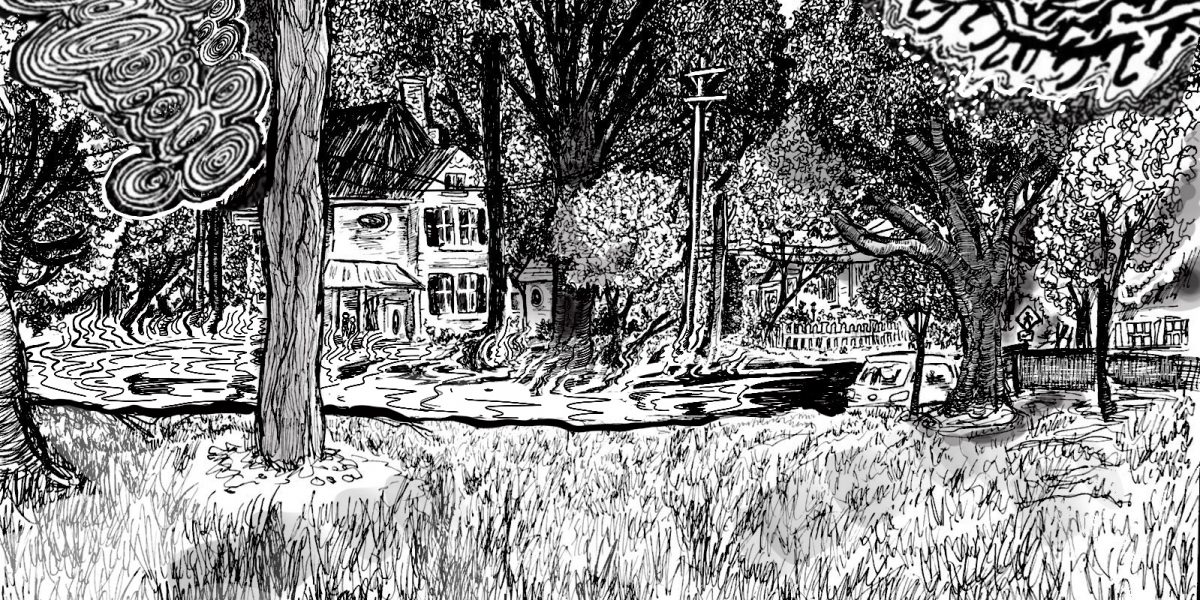
My love for visual art inspired me to try and create visual documentation of the interaction of a soundscape being present within a physical landscape. I was interested in the idea of how soundscapes interact with barriers, and how these perceived boundaries encourage or inhibit the soundscape would evaluate. I decided to create a drawing of the space and record how I visually perceived the sound. I chose to approach the assignment in this way because it provided a more immersive experience and offered a way for me to document my thought process and my perception of a soundscape while visualizing the environment.
Throughout the school year, I have enjoyed studying in this somewhat secluded spot on the south lawn of Chambers. This is a quiet part of campus, far away from many classrooms and social functions. The lawn is very much enclosed, as it is shut off on one side by the Martin Chemistry Laboratory and the Wall Academic Center on one side, and the Sloan Music Center on the other. The back side of Chambers blocks this square of lawn off from the rest of campus, and the busy Concord Street rushes by, cutting this lawn off from being part of the town of Davidson. I have always valued isolation that this lawn provides, as it is a definite part of campus, but feels so separate. In this project, I was encouraged to consider how the road acts as a dividing line, or a sort of sonic boundary, between the soundscape of Davidson College, and the residential homes just across the street. Sound is abstract concept when translated to visual imagery. Rather than attempting to draw musical notes or sound waves, I set out to depict how I visualized the differing sounds in the soundscape.

The keynote sound of this environment was the construction that was occurring further down, towards the intersection of Main and South Street. When I first arrived at the lawn, this was irritating, and I represented this sound as very noticeable and jarring (in the top right), but as time went on, the sound receded into the background, and I chose to have it merge with the tree’s foliage to represent that though it was present, I had adapted it and accepted it as a feature of the environment. A helicopter whirred by, producing unwanted sound, or noise. The rhythmic beating evoked concentric circles in the top left, and while the helicopter moved further into the distance, the presence of the helicopter within the soundscape diminished, as did the size of the circles. The road is the strongest partition between the quiet college campus and the town of Davidson. Two children were playing on their front porch across the street, but I could not hear them as cars rushed by loudly, but unlike the helicopter, their sound was not jarring and was far more of a continual stream of sound that I could not traverse. I decided to visually conceptualize this sonic barrier as a force rushing through the street, blurring and smearing the landscape behind it, mirroring the way the sound across the street was cut out of the soundscape due to the Concord Street’s noise level.
Though I often feel the necessity to categorize myself as such, I have recently been attempting to consciously avoid labeling myself as a “visual thinker.” As I considered this final essay, I repeatedly turned towards that idea and had to catch myself before I wandered down that rabbit hole of clichés and generalizations. Thinking is a conglomeration of different sensory features, and to label my thought process as a sequence of translating terms and stimuli into visuals feels like a capitulation that discredits the other sensory aspects of my thought process. I cannot purport to be a linguist, or an audiologist, or a musician, or anyone who can consider sound technically. However, this course provided the invaluable opportunity for me to critically understand sound, not for its own sake, but for the broader social implications it possesses, and the way it relates and operates amongst the other senses.
WORKS CITED
Szylak, Aneta. “This Lemon Tastes of Apple.” Hiwa K. 2011.
http://www.hiwak.net/projects/lemon-tastes/
Sterne, Jonathan. “Sonic Imaginations,” in The Sound Studies Reader, edited by Jonathan Sterne, 4–12. New York: Routledge, 2012.
Schafer, R. Murray. “The Soundscape,” in The Sound Studies Reader, edited by Jonathan Sterne, 95–103. New York: Routledge, 2012.
Barthes, Roland.“The Grain of the Voice.” in The Sound Studies Reader, edited by Jonathan Sterne, 504 – 510. New York: Routledge, 2012.
