
Listening to the variety of sounds on Davidson Campus and Main Street there is a clear differentiation between the atmospheres they create. The use of typing specific sounds helps formulate layers through which the importance and impact that sounds have on the location, can be determined. Modes of listening allowed the soundscapes to be understood in deeper listening exercises, helping understand the way the sounds formulate such specific actions of people in the two opposing areas.
As organisms, we have the ability listen to everything, to hear and pick up every sound that comes our way. Sounds like the ones we hear commonly in a specific area, tell us the location we are in. This leads to the understanding that as humans living in this complex society, certain sounds can tell us how to behave. The determination can be made that with each passing sound, a landscape of the environment around us is laid down, it is paved together almost like an architectural blueprint of a building, or land. Schafer in The Soundscape, evaluates, “…how sounds affect and change his [mankind’s’] behavior,” (Schafer, 96), which takes us into how the sounds on Davidson Campus creates an alternate behavior in comparison to the sounds on heard on Main Street. Sounds affect how mankind acts in an area, and Schaffer goes a step further trying to understand how mankind, “creates an ideal soundscape for that other life…” (Schafer, 96). By that other life, he means the distinction between the soundscapes form completely different realties, spaces – I use the spaces of Main Street, and the one on Davidson Campus. In attempting to differentiate the soundscapes of these places, it is integral to note that there is a very fine visible barrier between them, the area where the grass on the campus meets the sidewalk of the street. This barrier is able to separate the sounds from each area, keeping them distinct in their nature, holding an autonomy that provides the identity of the space. I chose these locations because of how central they are to my life right now, and how they differ greatly from any other areas I have lived in. As Schafer describes understanding a soundscape, he creates categories of different types of sounds, I will employ the use of “keynote”, “signals”, “soundmarks”, and “noises”, to enhance the purpose of the sounds heard on Davidson Campus and Main Street. When we listen intentionally to a space, we begin to understand the sounds that produce the qualities that manifest in that space specially.
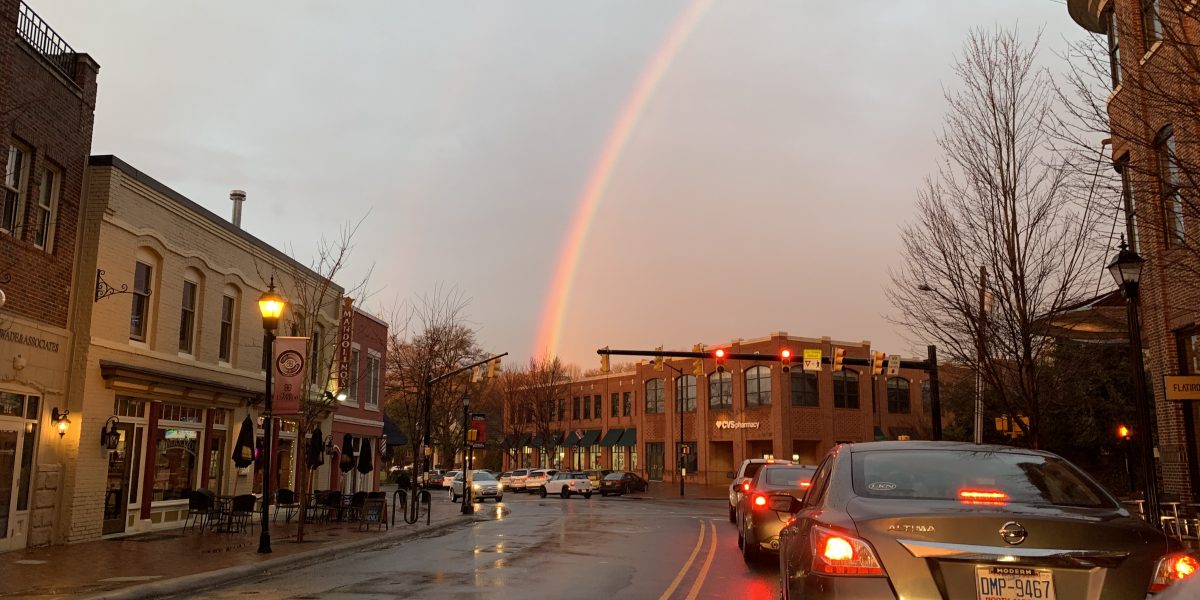
Main Street is symphony of loud and differing sounds. The movement, humming of cars are unavoidable and prominent to the area, as they are ‘soundmark’ sounds, they are “…derived from landmark and refers to a community sound which is unique or possesses qualities which make it specially regarded or noted by people…” (Schafer 101). The importance of these sounds is how they encapsulate the main points, essentially, of the area. ‘Noises’ as Schafer defines are, “sounds we have learned to ignore,” (Schafer, 95), and these become sounds of the people chatting. These are frequent and abundant, fading into the background, while the chiming of doors and footsteps trotting along exhibit properties of a keynote sounds, as they are sounds that, “…are overheard but cannot be overlooked…” (Schaffer 100). They force us to be listening to something that reminds us constantly of the location we are in. The ‘signals’ are, “…quite elaborate codes permitting messages of considerable complexity to be transmitted to those who can interpret them,” (Schafer, 101). These are the honks and speeding up of cars, as well as the voice of the pedestrian signal, that alert an individual to the alteration in the movements of the space. As I walked along Main Street the general perception, I got was that this was not a slow-moving space, it was not a space conducive to quiet activities, but rather held a community for gathering, of social interactions and meandering to be the norm. Sounds exhibited here focus the space to being loud and distracting, the forces of sounds are overwhelming, and brought me a higher sense of alertness. Together these types of sounds created by Schafer, produce layers of sounds ranked in a form of importance.
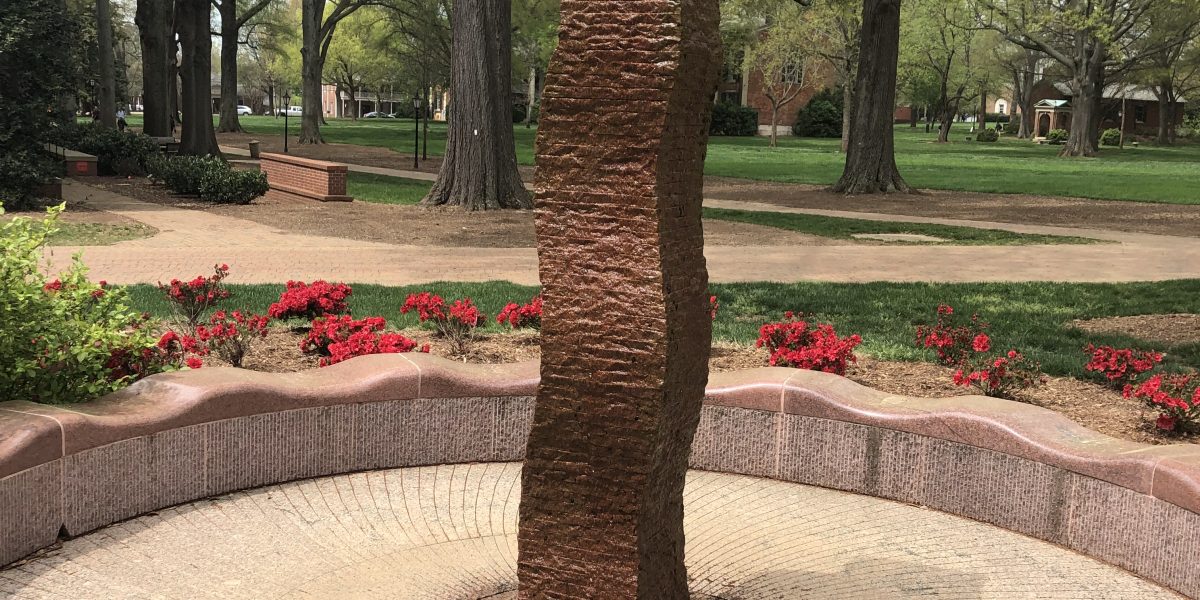
Sitting on the benches near the metal sculpture in front of Chambers at around 12:40pm, the movement along campus was slow. It was a relatively peaceful day with the ‘noises’ being the wind brushing through the trees slightly, and few footsteps were heard walking along the paths. As a result, I do not usually may much attention to the sounds produced by these ‘noises’, as they are usually hushed and isolated. Throughout the campus ‘soundmarks’ are heard, with the faint sound of the doors to Chambers opening and shutting every now and then, obvious by the ‘swoosh’ sound made by the door, and the speak of the button being pressed to hold the door open. While sitting there the Church Bells rang once, with their tune playing out for a couple of seconds, the humming and clanging of the bells creating a symphonic sound that engulfed the quiet campus. The sounds of two golf carts that were driven through the pathways caught my attention as they bumped along to paved paths. The sounds of both the church bells and golf carts are those of ‘signals’, telling a person that there is something different happening than the usual tranquility on campus. Keynote sounds I hear involve people chatting along the path, and birds chirping in the trees. These levels of sounds that formulate a map in my mind, of the campus, ranking the sounds for the understanding of how the sounds make the space, how sounds dictate behavior of individuals. Here on campus, the mindset of individuals is to be in a formal setting, a setting in which there is a constant sense of direction and purpose.
From the time Davidson College was built in 1837 the college has been committed to being “…a liberal arts college, to maintain itself as a residential community of scholars…” (Davidson College Website). This “residential community of scholars” is evident in the way the college acts on a daily basis, with the lawns outside the academic buildings remaining serene and quiet. Walking over the boundary, one is situated in the alternate hustle bustle of a small town that now holds a variety of stores that attract people daily from neighbouring towns. Main Street however, used to hold a similar soundscape to Davidson College, with a former student who graduated in 1993 saying that, “Main Street was completely dead, all there was for special occasions was this shitty chinese restaurant.” The complete change was at first shocking to the alumni who was impressed by how “new and busy” the location was. This change, while some can claim is only natural with a Division 1 athletic college near it, is even more interesting because of how the campus itself has still maintained its tranquillity.
The two soundscapes hold similar properties in that there are people conversing, people walking, exerted movements that can for a short minute or less alter the pace of the location. However, on Davidson Campus, the general pace is lower and slower than that of Main Street. While people are goal oriented, walking specifically from dorms to Chambers, or other buildings, people were not in general walking aimlessly or killing time, nor is their intent to socialize. This does exhibit the purpose of a college campus, holding academics during the day to be the standard activity, as well as at night in this space. Main Street is opposite as it did not enforce a specific route to be taken, people chatted slowly, or walked fast, either way their intentions were generally to be present in the area in order to dine, socialize, shop, or visit a place for a while. What was interesting to note was the differences in where people talking fell onto the types of sounds outlined by Schafer. On Davidson Campus people chatting became keynotes, sounds that could not be overlooked, while on Main Street these sounds became noises, turned away as sounds to be noted prominently. I find this interesting as if truly does show a difference amongst the spaces, with talking due to being so common and prominent on main street being able to become background noises, whereas on the college campus, as talking is rarer, people are generally keeping a quieter mentality, hearing someone speak cannot be overlooked. Both places have pathways, paths people are meant to follow, and paths that people for some reason do stick to following. Society has shaped both spaces clearly, with underlying societal norms being held in these two spaces, aside from the different ones that each holds individually.
Michel Choin’s The Three Listening Modes highlights a section of listening called reduced listening, as she says that reduced listening is, “the listening mode that focuses on the traits the sound itself, independent of its cause and of its meaning,” (Choin, 50), and says that it is useful as we can, “…benefit from [the modes] disciplined attention to inherent qualities of sounds,” (Choin, 52). This mode of listening bares use in understanding the purpose of the soundscape around us as it allows someone to hear the more melodic natures of the sounds, as opposed to what their context is. From this mode we see that the melodic tendencies of Main Street are a lot faster, hold a greater variety of tones and of pitches, than those of Davidson College, that inhabits quieter sounds, and a more generic tones and pitches. I will however deviate from avoiding the contexts, in order to show that this form of listening shows the deliberate mentality that people inhabit around these different spaces with different melodies.
Each level of sound that is heard enforces the layout of the area you are surrounded by. Schafer’s distinction of types of sound creates categories by which we can understand the meaning and importance of the sounds that show what is held by humans as a typical sound to be found in this space, or a sound that this perhaps not common or meant to occur in the space. Both Schafer and Choin provide ways through which one can begin to realize their surroundings and understand how the space became that space. By Schaffer’s terms we can see the differences between which sounds are background noises and which are more in the forefront. Schafer’s terms further allow us to then understand why each sound in holds that definition, which ends up relating to the fact that in a different soundscape we act accordingly, and as a result the sounds that I observed are that way because the space was created to be a specific way, but as the circle must be completed, because the sounds exist the way they are, people happen to act in a specific manor.
Citations:
Choin, Michel. 1994. The Three Listening Modes. In Audio-Vision. Translated by C. Gorbman. New York: Columbia University Press. Pp. 25-34.
Schafer, R. Murray. 1994. The Soundscape. In The Soundscape: Our Sonic Environment and the Tuning of the World. Rochester, Vermont: Destiny Books. Pp. 3-12.
“Statement of Purpose.” Davidson College, www.davidson.edu/about/statement-of-purpose.