
Abstract
For this Davidson Soundscape Project, I have chosen to study the sounds of the main dining hall on campus, Vail Commons. I spent thirty minutes listening to the surrounding noises for each meal of the day on a Wednesday since it falls in the middle of the week. For each meal I sat in the exact same seat, in the back row of tables because it presented the most amount of exposure to different sounds. Throughout this essay I will interpret the different sounds I heard at each meal and analyse how they reveal certain differences at each point in the day. Furthermore, you will find that breakfast allowed me to highlight the social differences between the employees and the students that I have never noticed before. Additionally, lunch has touched upon the various social interactions both between students and other students, and students and faculty. While, dinner emphasized these social interactions even further. Overall, the entire project represents the important of soundscapes and how they can reveal various ideas about the surrounding environment.

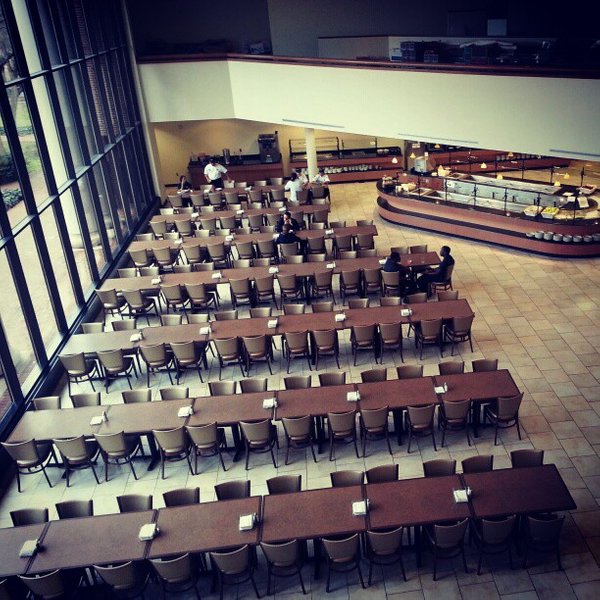
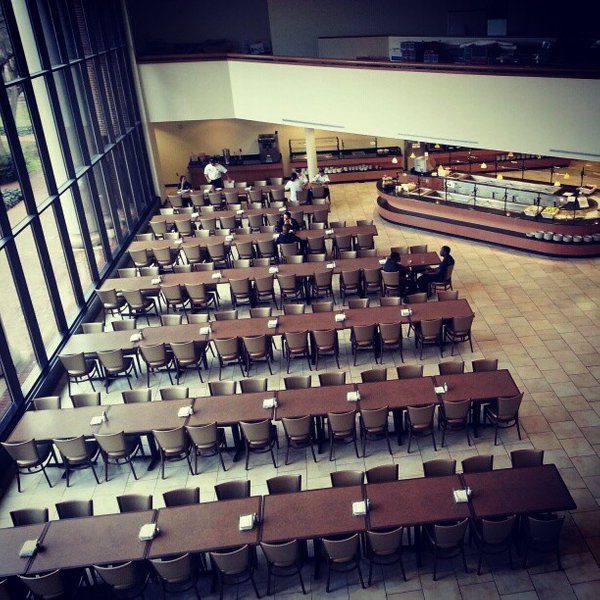
Vail Commons is the main dining hall at Davidson College and is accessible to all students and even faculty and people of the community. It runs as a buffet-style and splits the seating into two sections. One side, which is not always open to sit, is filled with mostly circular tables seating at least eight people and is sometimes referred to as ‘the dark side’ because it is typical for students doing homework or eating alone to sit on this side. The other side, the main side, holds multiple rows of long tables seating from eight up to sixteen people at each one. The food is set up in the front half of the main side while the station for beverages divides it from the dining tables. Many students have sat in both sides of the cafeteria but I decided to sit in the last row of tables on the main side for my soundscape listening. Here, I had audio access the most amount of food stations at one time including the salad bar, the grill, the sandwich bar, the dessert bar, and the cereal bar. For all three meals of my Wednesday, I sat in the same spot and explored the soundscape around me. Wednesday fit best to ensure there was no influential factors to the overall population from a long week or weekend.
At 8:30am, I sat in this specific spot for thirty minutes and simply listened to the sounds of breakfast. Here is a small ten second clip from breakfast.
During this time I took notes on the various sounds I heard and finished with the following:
- Deep, loud scratching on floor: pulling chairs out
- Distance sounding/televised voices: from someone’s phone playing a video
- Sound of two solid materials clinking, probably metal: utensils
- Scraping of two solid materials; repetitive for a few times then stops: people scraping food off their plates to compile the waste
- Heard two text tones or phone notifications
- Fast and immediate, then slowly fading sizzle; from the grill, eggs? Peppers?
- Repetitive quick/short bursts of thin metal clinking with a hard surface: grill scrambling the cooked eggs with a spatula
- Sudden collapse on the metal tray at the bottom of the toaster
- Repetitive short bursts, but longer lasting and slower speed bursts than above, of two different solid materials scratching; people cutting their food on their plates
- “Creaks” and small, random “utility noises”; toaster turning or refrigerator functioning
- Crashing sound of ice cubes landing in hard plastic cups
- Conversations: only hear about three conversations (1) the people a few tables away/next to me, (2) employees speaking another language to each other in salad bar (3) loud people in the middle
- Physically hear an emptiness to the area, maybe just because most people imagine commons as loud so my expectations perceive it that way
Overall I noticed during breakfast some people seemed to try and be quiet since it fit with the sounds they heard. They were not necessarily quiet with the things they were doing that seemed small and unnoticeable but they seemed to try and quiet the sounds of the actions in which they were aware of the loudness and resulting sound. Many of the sounds which took over the soundscape during this meal were the various materials such as trays, carts, and utensils, proving the focus seemed to be the way the food got from one place to the next ending at the mouth of the students. This sparked the significance of the soundscape in revealing the interactions between workers and students, as the sounds highlighted the workers tasks to prepare food to serve students.
Then, at 12:30pm I sat in the same exact spot for another thirty minutes and listened to the sounds of lunch. The following is the short audio clip and notes I recorded from this meal:
- Cereal rustling in the plastic containers when the employees refill them at the end of the breakfast wave
- Slam of the fridge/storage being opened and closed; to bring out new dishes
- Sounds “busy”
- More conversations, slightly more laughter
- Employees yelling names for food on grill that was piling up when they were getting busy
- Same silverware and plate sounds but more often (chairs, cups, scraping plate)
- Hear a cart rolling around when they’re switching from lunch to breakfast bc they switch all the trays and put the old ones on the tray and wheel it back
- Individual conversations are louder
Finally, at 6:50pm I sat in the exact same spot for thirty minutes and listened to the sounds of dinner. The following is another short recording and the notes I recorded from this meal:
- Individual conversations are much louder (much bigger groups of dining tho – athletic teams)
- Deep, resonant laughter from students
- Thin metal scratching and scraping against a different surface; silverware scraping on people’s plates rather than people grabbing them
- Slam of the fridge/storage being opened and closed; to bring out new dishes
- chairs rubbing and sliding/screeching across floor, sound is more vicious
- Decently occasional singular, flat ‘bang’ or ‘slam’; trays being dropped on tables
- Sometimes you just simply hear chatter but you can not actually make out any specific conversations or voices it is literally just sound waves (only when there is so much noise that it all blends together)
Essentially, while approaching this project I attempted to incorporate Michel Chion’s and Schafer’s listening and sound concepts. Schafer’s features of the soundscape introduces the terms: keynote sounds, signals, and soundmarks. Although the terms’ have a unified definition, there are no sounds that are specifically defined to fit with any of these terms. Thus revealing that listening is a completely interpretive and unique experience for each person. Still, during my listening process of this soundscape I incorporated the sounds to each of these terms.
Chion’s three modes of listening seemed to fall into their own place after I heard each sound. To further illustrate, Chion explores the three listening modes: casual, semantic, and reduced. He defines casual listening as, “listening to a sound in order to gather information about its cause” (Chion 48). Identifying the ‘distance sounding/televised voices’ as voices from a video on someone’s phone is casual listening. Additionally, Chion explains different levels of casual listening say that we can identify the general nature of a sound and even identify the pitch or pressure and speed changes in the sound without even knowing what it is coming from. I know the grill scrapping is coming from the grill and some metal thing but I did not identify exactly what. I also know that the sizzling is coming from the heat of the grill and the food and I noticed the tempo of the sound – “fast and immediate, then slowly fading” – but I have no idea which specific ingredients make the sizzling louder or faster, or if the cook is doing something unique to create that sound. On the other hand, he states reduced listening, “focuses on the traits of the sound itself, independent of its cause and its meaning” (Chion 50). I found that while listening to the noises this way it was not only very difficult to describe but also after I did it still lead to the source of the sound. The “sound of two solid materials clinking, probably metal” was initially listened to in a way to understand the traits of the sound but it eventually lead to labeling the source of it as metal utensils. Lastly, he introduces the term semantic listening, which, “refers to a code or a language to interpret a message” (Chion 50). Similar to identifying a source to specific sounds, I interpreted the sounds in ways that could have revealed a specific message to some. For example employees called names can signify to that one person that their food is ready, the phone ring signals a notification, and the sudden collapse on the metal tray at the bottom of the toaster signals someone’s toast is ready. In a way, listening to the soundscape in a way that incorporates all listening modes allowed me to put together the different aspects and considerations with each sound and overall helped me compare each meal’s soundscape with the others. Together the soundscapes reveal information about the differences between students and employees. The semantic sounds of breakfast versus the semantic sounds at dinner emphasize the changes in which sounds as identified as significant and represent meaning. In the same way, the sounds that evolve from being heard through reduced listening to semantic listening displays the change in how sounds are given a meaning at different times and in this case different meals of the day.
On the other hand, when comparing each soundscape using Schaffer’s sound terms I found that the changes in each term also reveal the social interactions and differences between the groups of people in Commons. Schaffer’s keynote sound is “the anchor or fundamental tone and although the material may modulate around it, often obscuring its importance, it is in reference to this point that everything else takes on its special meaning. Keynote sounds do not have to be listened to consciously; they are overheard but cannot be overlooked, for keynote sounds become listening habits in spite of themselves” (Schaffer 100). Keynote sounds are the main sounds in which represent the natural soundscape despite whether we recognize them or not. During breakfast and lunch, sounds of silverware and employees clashing metal trays are signals of resupplying the food or soundmarks which uniquely define the dining aspect of Commons. Yet during dinner these same sounds are interpreted as keynotes because they are much less obvious and overheard because they are hidden by other stronger sounds. However they are still just as present and represent a significant part of the soundscape. The separation between the employees and the students that are eating is splitting further as the day reaches to dinner and the sounds are further separated. Schaffer claims, “even though keynote sounds may not always be heard consciously, the fact that they are there suggests the possibility of a deep and pervasive influence on our behavior and moods” (Schaffer 101). Here easily explains the difference in volume during the different meals as more and more people are in Commons creating more sounds not only does that add to the volume but also the sounds add up together to influence people’s behaviors and moods potentially increasing the excitement and enthusiasm during busy hours such as lunch and dinner, which further increases the volume and amount of sounds. Similar to Chion’s semantic listening mode, Schaffer says, “signals are foreground sounds and they are listened to consciously… Sound signals may often be organized into quite elaborate codes permitting messages of considerable complexity to be transmitted to those who can interpret them” (Schaffer 101). Meanwhile, soundmark, “refers to a community sound which is unique or possesses qualities which make it specially regarded or noticed by people in that community…for soundmarks make the acoustic life of the community unique” (Schaffer 101). Sounds unique to Commons include the stacking clash of solid ice falling into the plastic cups because of the fact that all people who frequently eat there know that is the only dining hall with those cups and everyone is so aware of the sound. It is close to the keynote sounds however these sounds are more unique and, in a way, sentimental to the people involved in the environment.
To further illustrate and explore the social differences of commons, I noticed that the transition between sounds of breakfast and sounds of dinner were emphasized during the lunch wave. For example, the sounds of the silverware was very obvious as there were more and more people grabbing silverware but because those sounds required more of a reduced listening and were soundmarks they were covered by the many conversations going on and the tasks people were doing such as switching metal food dishes and clashing plates onto their trays. During breakfast and dinner these sounds came from opposite ends essentially meeting in the middle during lunch. Clinking and clashing of hard metal utensils during lunch represents the rush of people to quickly get the food they want and the rush of workers to supply and resupply the food, utensils, and condiments in order to satisfy the students. At dinnertime, the conversations and other sounds controlled directly by the students were overpowering the sounds of employees hard work, emphasizing the social differences and unique interactions between the people involved in the soundscape of Commons. On the complete other side of it, breakfast reveals the sounds are almost all coming from aspects controlled by the employees due to the quietness and calmness of the soundscape as a whole. It draws more attention to the employees and their individual task.
Overall, I have found that while dinner at commons does tend to appear louder and includes an increase in the frequency of sounds, these same sounds are still happening at each meal. However, this process revealed many important aspects through the soundscapes. In other words, through Chion’s different modes of listening and Schaffer’s terms to describe the features of a soundscape one can see how the interpretation and significance of these recurring sounds reveal truths of the entire community and environment. As I sat and listened in periods of thirty minutes the compared and analyzed each time frame I noticed the change in each sound and how it signifies specific interactions between students and employees at Commons. Whether the interactions are good or bad is not the argument but rather that the soundscape teaches listeners the hidden aspects and provides a different perspective that one may have never interpreted.
