Abstract
The Davidson campus is a beautiful and scenic setting with many interesting soundscapes. The outdoors seems to dominate most of the conversation surrounding both the campus and its respective acoustics; and so, it was only fair to analyze the “natural soundscape of Davidson”. To accomplish this, I used my iPhone to record videos and pictures of the different soundscapes and explored their environmental and cultural contexts, and the role they play in what makes the soundscape of nature. Through discussion of three soundscapes differing in origin, I attempt to find the connection between what I deem “natural” and “artificial” sound.
The Natural Sound of the Unnatural
Since the beginning of the industrial revolution, and perhaps even before, the sound of the manmade world seems to plague and contaminate the soundscape of the natural world. Within everyone lies this distinct association between metallic cacophony and the artificial world of transportation, industry, and technology. On the other hand, the natural world is often credited with its pleasurable and peaceful soundscape. The sound of a rooster waking everyone up at the crack of dawn or the sound of small waves crashing gently against a shore are culturally ingrained in the minds of listeners. This binary opposition between natural and artificial sound and their corresponding associations of peaceful and organic, and perverse and obnoxious tell us a great deal about the power and effects of soundscapes in the human mind. However, these associations are nothing short of stereotypes, as this rule is by no means concrete and often contradicted. The Davidson College campus provides a perfect plethora of real-life examples which serve as counterarguments to this. With unpleasant natural sounds, pleasant artificial sounds, and even seemingly natural manmade noise; the Davidson soundscape shows us that the human perception of natural and artificial noise is much more complex than good and bad. The Davidson soundscape shows us how often the soundscape itself is all we hear, rather than the noise producing it.
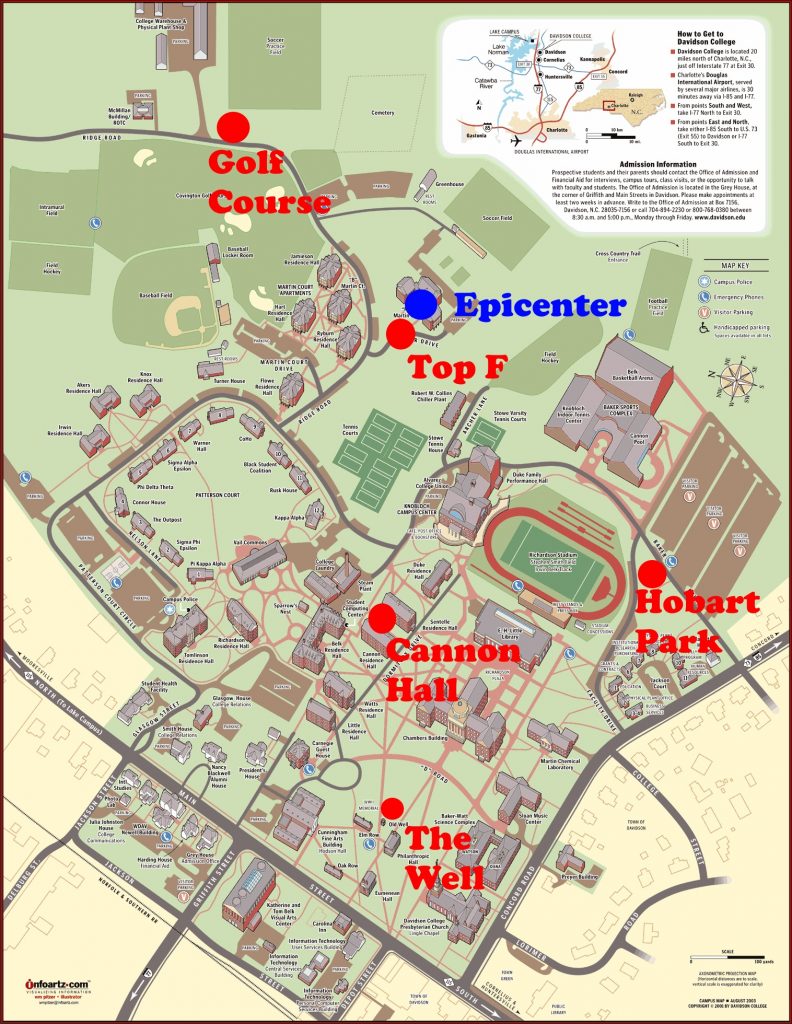
While the sound of nature is too broad and vague to be categorized as pleasurable or calm, it is certainly portrayed as such. However, not all the sounds of nature are as peaceful and soothing as the crashing of waves or the gentle hymn of insects. As a matter of fact, the hymn of insects can be quite the opposite, as observed on the path between Baker Dr. and the Duke residence hall. Between the two there is a small strip of trees and dirt with some wooden chairs; a rather pleasant and green setting. However, on any given night above sixty degrees without rain, the unmistakable call of cicadas drowns out just about any other noise. The incessant ringing is reminiscent of a broken air conditioner. In Michael Chion’s The Three Listening Modes he mentions three forms of listening of which one is particularly useful for observing these sounds in nature. Via “Reduced Listening”, we can listen to a recording of the cicadas as opposed to being in the presence of the sound, and the sound itself becomes much clearer and loses the natural and peaceful aspect of the soundscape. Instead of looking for the cause of the sound, such as in casual listening; we entirely disregard the cause and associations that come with it, leaving nothing but the sound itself and its individual soundscape. Upon listening to the recording below, the noise emitted is more reminiscent of the static from a television rather than any insect. While the individual might hear many different varying sounds, there is a common unpleasantness to the constant high-pitched, monotone ringing. Despite being the epitome of natural sounds, the cicadas are anything but calm and soothing.

Aside from the fact that natural sounds can certainly be unpleasant, artificial sounds can indeed be pleasant like certain natural sounds. Between every class period, all of Davidson College hears the Chambers bell resonate throughout the campus. When the bell was built is unclear, but it’s fair to assume it was built at the same time as “new” Chambers itself in 1929. Upon casual listening, one would most likely associate this bell with the obnoxious reminder that they are late to class, and the loud ringing sound all too similar to an alarm clock waking up a student for a dreaded eight-in-the-morning lab. However, through Reduced Listening we can once again shed the misconceptions of soundscape as a result of cause or meaning and focus on nothing but the sound itself. What was once an omen of missing the attendance sheet and nothing more than loud metallic clanging has become an entirely different scene. The old and historic sound of the bell echoes throughout the lawn and seemingly disassembles into its natural components of wood and metal. As the sound flows through and resonates off the trees, grass, and buildings on campus it becomes harmonious in the natural soundscape rather than disruptive. The soundscape feels historic and elegant, perhaps as a result of the bell being an ancient tool. Nonetheless, this centerpiece of campus is quintessential in the minds of students, faculty, and alumni as the sound of Davidson. This loud, metallic, artificial sound is anything but “noise pollution”.
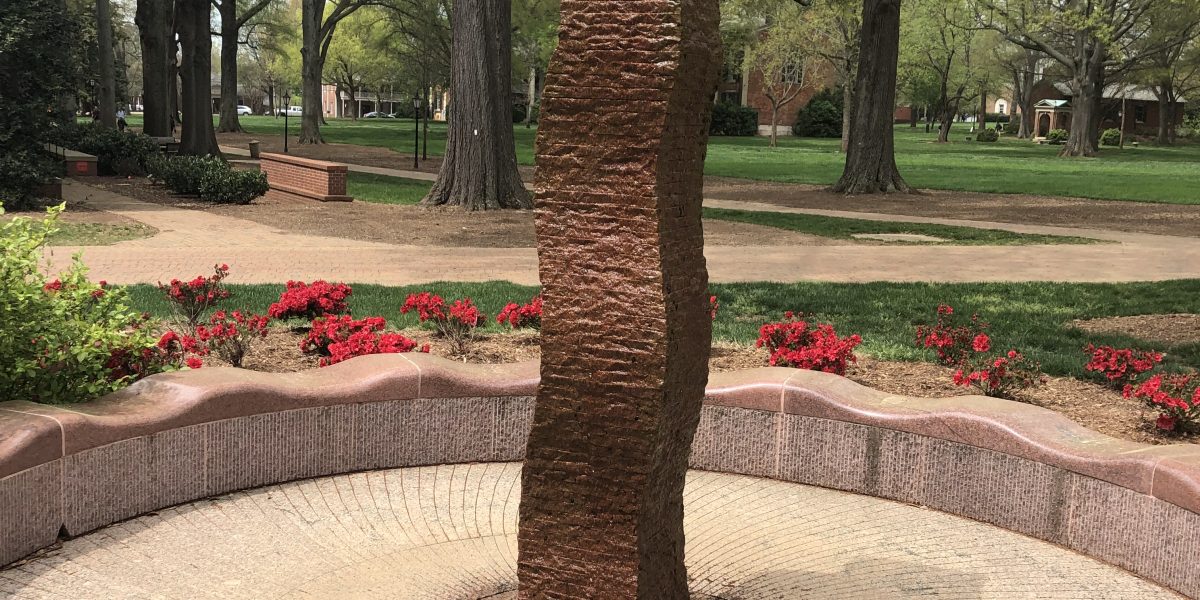
Lastly, not all sounds can be categorized into the oversimplified binary opposition of the “natural and artificial”. The reality is that there are gray areas within this topic, and there is no better example than the Spirit Waves Fountain on the Davidson campus. At the Davidson college campus there is a building known as the Sloan Music Center, and its main hall is the Tyler-Tallman Hall. Additionally, the rear/right side of the building is facing the Chambers lawn, the middle of the campus; a scene commonly filled with students laying down enjoying the spring weather. Between the two, next to the chairs and stairwell there is a red-brownish sculpture, titled Spirit Waves Fountain. Given to the college as a gift of Dr. Hugh A. McAllister, Jr. Who graduated class of 1961, this ornate fountain is made of Texas pink granite and Fredericksburg granite. The setting, including the hall and lawn not just the fountain, compose one of the most unique soundscapes on campus. Without a calendar you could tell it’s March just by the distinct call of the birds and the cool sixty-degree breeze that rolls by. Yet, the sound of subtle rushing water and the distant sound of leaf blowers/ lawn mowers would argue for June. Additionally, the sound of the Spirit Waves Fountain itself is a distinct, gentle rushing water sound, unique to just about all fountains that don’t have some form of splashing or an angel peeing. The sound of this gentle water is often associated with a pond or creek and is quintessentially “natural” in the minds of people, yet the fountain itself is certainly a manmade structure. When we consider the soundscape formed by the culmination of all the sounds around it as well, without letting the actual setting influence it, the soundscape produced mimics that of a stream hidden deep within the woods. Within this soundscape, all the sounds are natural but there is one that is distinguished from the rest. The sound of the rushing water is the keystone of the portrayed environment, there is something uniquely natural about it. Yet, the fountain is the only artificial sound in the soundscape. The Spirit Waves Fountain is the paragon of artificial creations with natural soundscapes. It is not the sound itself which is natural, but the association of peaceful noise.

As stated by Schafer, “The soundscape of the world is changing. Modern man is beginning to inhabit a world with an acoustic environment radically different from any he has hitherto known.” As illuminated by Schafer, the old soundscape of the world is rapidly changing as the abrupt and turbulent uproar of industrialization contaminate the acoustic world. However, many hold the misconception that the changing world can be split into two rigid categories of natural and artificial. Additionally, with this fallacy comes the grand oversimplification that these categories can be monolithically summarized as pleasant and tranquil, or deafening and disruptive respectively. The Davidson soundscape and these three locations with their own individual soundscapes argue that the line is not so clear. There is no true relationship between sounds that are deemed natural and what we consider to be pleasurable. After all, the soundscape itself is not natural. It is a culmination of all our subconscious associations with the noise we interact with, manifested into a figment of imagination that strives to encompass not just hearing, but all five senses into one singular setting. It is not the sound of the man-made world that pollutes the acoustic world, but the soundscape itself produced by it. The soundscape is louder than the sound.
WORKS CITED:
Chion, Michael. “Michael Chion 3 Modes of Listening.” Artcites.uscs.edu.
http://artsites.ucsc.edu/faculty/gustafson/FILM20P.W11/readings/chion.3modes.pdf
“Natural and Artificial Sources of Noise Pollution.” Pollution Control Board, 31 Jan. 2014, www.pollutioncontrolboard.org/essays/noise-pollution/natural-and-artificial-sources-of-noise-pollution/186.
Schafer, R. Murray. “The Soundscape,” in The Sound Studies Reader, edited by Jonathan Sterne, 95–103. New York: Routledge, 2012.