Abstract: Spaces are often designed with the purpose of amplifying or diminishing sound. Is there evidence of this kind of architecture in our campus study spaces? Aside from Union, most study spaces place an emphasis on remaining quiet to allow for maximum productivity. It would be useful for the campus to invest in architecture to help achieve these goals. I don’t believe that people who open themselves to auditory distractions are being as productive as they possibly could. In this project I study three popular campus study spaces to discern how their architecture plays in to their effectiveness and popularity.
In his book, The Soundscape: Tuning of the World, Raymond Murray Schafer toys heavily with the term “noise pollution”. He believes that rather than seeking to just minimize noise pollution, we should study it and learn from it—eventually with the goal of more effectively eradicating it. As college students we often lack the time to study our soundscapes and instead need to minimize noise pollution so we can learn what we need to for classes. Innovative sound experimentalist and member of the Talking Heads, David Byrne, has a TED talk where he explains to viewers how historically people have made music to fit the spaces they’re in. Likewise, spaces are often constructed for certain types of music or with sonic goals in mind. By studying the architecture of a space, one can gain insight into the levels of sound meant to exist there. I wanted to use the ideas generated by Schafer and Byrne to try to identify the best study spaces on campus and to tell if Davidson College designed its buildings with enough attention to magnify student productivity. While making these decisions I’m operating under the assumption that the best study spaces are the least distracting ones. I believe this so strongly that I rarely study without noise canceling headphones. Therefore, the goal should be quietness. I’ll be observing three such spaces: the second floor of the library, the top floor of the student union, and the base Belk study lounge. I’m keeping the list narrowed to only three and leaving out other popular study spaces like Chambers and Wall so that I can dedicate in-depth analysis to the places I’ve chosen. I plan to explore the three spaces in terms of their general conducive-ness to productivity and in terms of the college’s motivation in planning them.
The library is the first place that comes to mind for most people thinking about studying. Ours is interesting in that there are different expectations of noise levels for each floor. The basement is completely silent, but also is dark and smells so it’s not very popular. Actual studying rarely happens on the first floor, it’s a more social place than anything else. For that reason, I’ve chosen the second floor to analyze for this project. The second floor’s policy is polite, non-distracting whispering. If the first floor of the library’s open floor plan encourages talking, the tall bookcases that take up the majority of space on the second floor do the opposite. Still sound drifts up from the floor below and is louder the closer you sit to windowed wall of the library. The voices discernable in the recording attached come entirely from the floor below. However, you’ll notice that they are the only thing heard in the recording. The further back one sits from the balcony, the quieter they get until they can’t be heard at all. The bookcases and carrel walls serve to minimize disruption on the floor. I asked my friend Mary Kaufmann why it is that she prefers to study here. She said, “It’s quiet, but if I make a noise I’m not going to get a dirty look.” So, as well as being relatively silent, the atmosphere on the floor makes her comfortable. To use Schafer terms, I would argue that the second floor of the library has no signals, or sounds that are listened to consciously and contain messages. The keynote, or sound that almost unnoticeably establishes the character of the soundscape could be the hum of the AC or sound of papers rustling and computers typing. The biggest soundmark, or sound that calls attention to itself, from my perspective is the voices from the first floor. For that reason, I find them distracting and usually need noise canceling headphones to be really productive at the library. I think it’s clear to most that the library was designed with studying in mind. That being said, it was built a long time ago and the renovations made between last semester and this semester prove that even the college admits that it probably isn’t the most conducive to concentration that it could be.
I’ll be candid and admit that as a study space, the top floor of Union doesn’t impress me. Nevertheless, it seems fairly popular. I sat on the top floor to take notes on it for this essay. It has an open floor plan that surrounds a large hole which one can look down into and see everything on the floors below. This means that you’ll see people you know as well as hear them clearly. The top floor has lots of seating and the students there are mostly quiet, but it makes no difference among that roar that drifts up from the lower floors. In Barry Blesser and Linda-Ruth Salter’s essay “Ancient Acoustic Spaces” they return multiple times to the similarities between large churches and underground caverns. Both have high walls and irregular geometry that reflects sound into every orifice of the area. Union gives me the same feeling for how shockingly easy it is to hear each individual voices on the two floors below. As I sat, I couldn’t even stay concentrated enough to continually take notes on the space. I meant to make a 30 second recording of the sounds, but on my first trip there I was so distracted that I forgot to do it. Still Union is popular. This is likely because of the proximity to the Union grille food. It’s a good space for the social butterfly, but truthfully not conducive for efficient work. When I asked student Grace Olson why she sometimes used the Union to study she said, “I used to do it between my 8:15am and lunch”. So, the proximity to food drew her in more than anything else. Union is great as a hangout and eating space. It’s vital for campus life, just not to campus academic learning. The college likely designed it with these in mind, not studying. So, there is no reason to blame the college for its inefficacy as a study space. The keynote sound is the constant roar of voices making it far from peaceful. Generally, any place that is defined by a sound so loud wouldn’t make for good concentration.
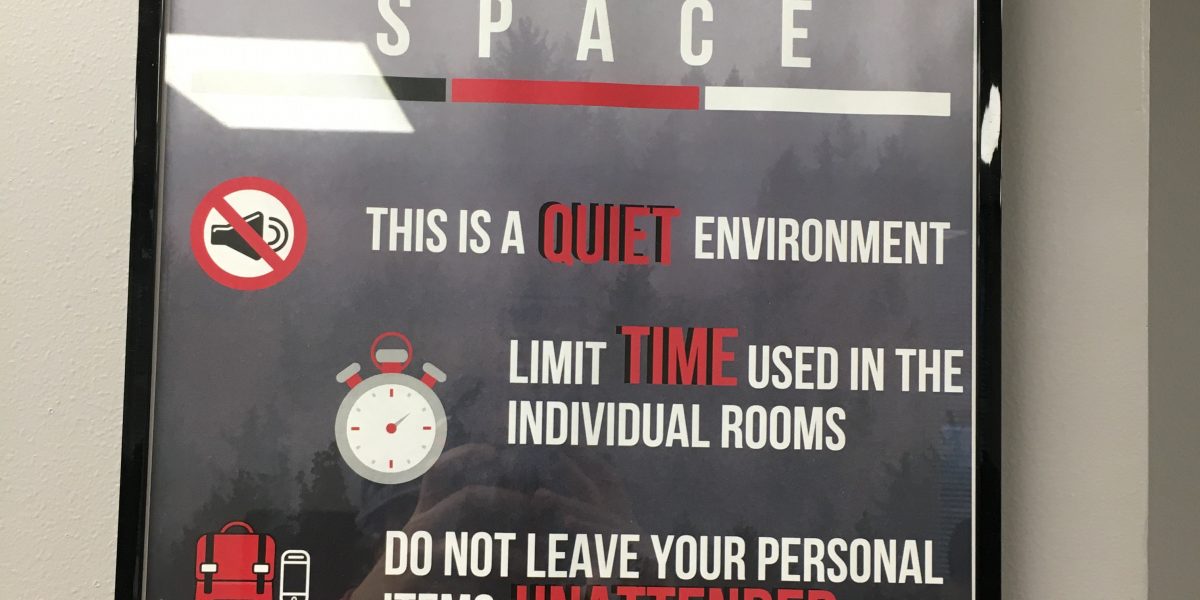
Base Belk study lounge, which opened this semester, is Davidson’s newest study space. The small-ish room has desks with blinders, four connected small study rooms, and is lined on one half by cloth covered cubicles. The low ceiling, carpeted floor, and cloth materials all work to dampen the sound made in the room. The signs pasted on the walls proclaim it to be a “quiet study space”. This leaves no doubt about the college’s intentions for it. It’s overwhelmingly popular. If you visit on any school night, it will be completely packed. This is in part due to the convenience of having a study lounge in one of the largest dorms on campus, but also clearly stems from more as proven by the frequent presence of upperclassmen. My roommate Lizzie Kane told me, “I go to study in base Belk lounge because it is mostly silent, and I need silent spaces to do work effectively.” This sentiment is popular among students at Davidson, with even seniors making their way to the study space. This new study space is quiet, popular, and effective. It ideally has no soundmarks or signals. The keynotes are what is heard in the recording: the barely-there hum of the AC and the clacking of typing on laptops. Base Belk lounge is evidence that the college is learning how to accommodate student’s needs and promote the competitive learning environment we’re known for.
Designing a campus is inarguably a tremendous amount of work, but I don’t think it’s too much to ask that spaces be provided that make it so students can effectively learn. Clearly Davidson College doesn’t either. Even if it wasn’t perfectly designed in the first place, our college is constantly renovating and building. This year in the basement of Belk hall alone steps have been taken to add a highly appreciated study lounge, the Lavender Lounge for queer students and allies, and the Resident Life Offices are being moved out to a new renovated building to make space for more dorms. These are all great steps; I would just caution the college to keep in mind how the design of spaces can affect its acoustics and in turn affect its usefulness. This quick project undertaken by one student easily revealed that it is possible to be more mindful about the architecture of our campus and the noise level/types of sound it invites.
Citations:
Blesser, Barry, and Linda-Ruth Salter. “Auditory Awareness as an Extension of Religion.” In Spaces Speak, Are You Listening? Experiencing Aural Architecture. Cambridge: MIT Press. 2007.
Kane, L. (2019, April 4). Personal Interview.
Kauffman, M. (2019, April 4). Personal Interview.
Olson, G. (2019, April 5). Personal Interview.
Schafer, R. Murray. The Soundscape. A.R.C. Publ., 1978.
“TEDTalks: David Byrne–How Architecture Helped Music Evolve.” Performance by David Byrne, TEDTalks: How Architecture Helped Music Evolve, TEDTalks, 2010.
