Sarah Hardy
WRI 101
Professor Rippeon
8 April 2019
Abstract:
With over 25% of Davidson students playing on a varsity athletic team, the soundscape of a sports practice is widely familiar to many students. Life at Davidson is hard enough, but combined with the extreme pressure of competing at a division 1 level, and the constant noise at practice, simply living our lives becomes deafening. I play lacrosse, and will discuss both the sounds heard, and unheard, at practice along with the noise athletes create in our own heads while playing. I explore how the mind tries to tune out background noise to focus, and how this intensifies the constant noise in our minds. As athletes, we are strive for a happy balance between myopic focus and environmental awareness, and it is quite possible that the key to this balance comes from sound.
Human beings long for silence. We drive ourselves mad longing for a sense of peace in a world filled with unwanted noise, searching for quiet that can calm our frantic minds. On the rare occasions that we are able escape the cacophony of car horns, pedestrian chatter, bird song, and text-tones, odds are that silence still evades us. Environments that are considered quiet, without the “keynote sounds” of modern society, are actually filled with noise: the hum of the air conditioner, the sound of our own breath, and the soft whirl of wind hitting the window are sounds that are almost inescapable. Further, in places that lack obvious noise there is an even more intrusive “mental chatter” that inundates the stillness of our minds, a time when our own thoughts become so glaringly loud that silence seems unattainable. As a college athlete, I know all about the annoyance and frustration that an overabundance of noise can bring to my life. One of the biggest distractions I face during a game or practice is unwelcome noise, whether that be from the cheers from the crowd, the other team’s insults, or the constant shouts of negative thoughts from my own head. As athletes we are taught at a young age to block all of these things out, to create a self-made inner silence in a world of chaos and disturbance. This past year, however, I have learned that this coveted silence is not everything, and that it can be detrimental not only to my performance as an athlete but my life in general.
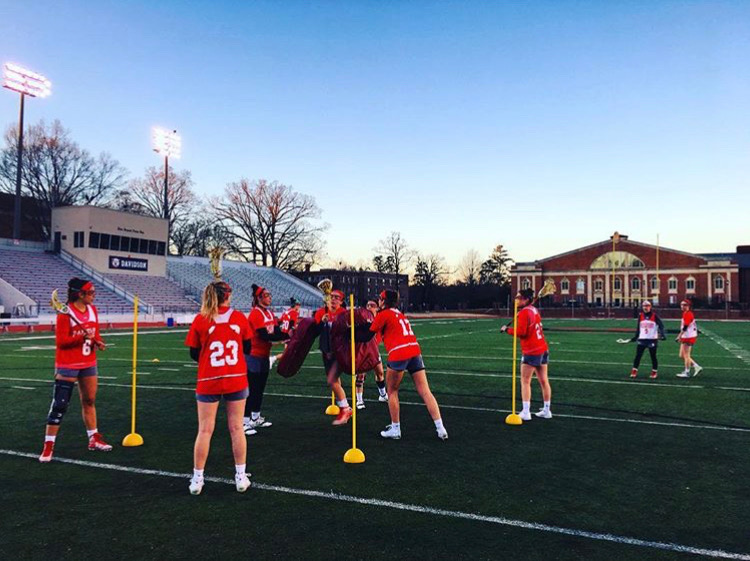
Typically, during lacrosse practice I hear little more than the obvious sounds around me – my teammates talking through plays, my coach giving instructions, and the occasional ball hitting the pipe. After being sidelined with an ACL injury though, unable to participate in practice, I have had a lot of time to sit and listen. There was not much else to do, so I threw all of my energy into hearing as many sounds as possible at practice. At first, I was skeptical as to how many sounds I would actually hear, but I found that there are a myriad of sounds that I had been blocking out all these months at practice. To start, there was the wind. It rustled through leaves, softly brushed the back of my neck, and flicked through pages of our playbook quietly. Then, there was the intermittent sound of track boys running by. They run in packs of four or five and their feet clapped the track harshly as they shuffled past me, slowly coming in and out of earshot as they proceed on their lap. I could hear their broken breath, and as they heaved in, trying to get their heart rate down, their breath hit the back of their throats jaggedly. I also focused on the sounds coming from my teammates. There was, of course, lots of talking and shouting from down the field. Words I couldn’t make out all the time, but almost always I could hear the urgency behind the words. Feet stomped the turf angrily, scuffing up plastic bits as their toes dragged. When the ball hit the pocket of their sticks, there was a sharp pat. The balls collided with the tough strings and the strings gave in to the hit. There were painful grunts as my teammates hit each other, and as one player’s stick slapped the waist of another there was a dull thud that reverberated into the air. These once-ignored noises have without a doubt been occurring all year, but this was the first time I had truly taken notice of them.
One theory behind my inability to hear all of this background noise during practice is that of inattentional deafness. This theory states that when focusing on an intense visual or mental task, we unintentionally become deaf to the extraneous sounds around us. Inattentional deafness could explain, for example, why your friend doesn’t respond to you while he is texting on his phone – he is not ignoring you, but rather simply cannot hear you. As athletes, inattentional deafness seems to be the key to blocking out distraction. Interestingly, it creates a positive feedback loop where the act of fully focusing on the lacrosse game causes us to filter out any noise that could potentially pull our focus away in the future. Many athletes refer to this phenomenon as getting “in the zone”, where one’s focus is so absolutely acute the mind cannot process anything going on around it. When I was younger, I believed that blocking out sound around me would create a more conducive environment for athletic success. In the past few years, however, I have realized that this self-made deafness is not as useful as I once believed. As Science Daily explained, inattentional deafness “has more serious implications in situations such as the operating theatre where a surgeon concentrating on their work might not hear the equipment beeping” (“Why Focusing on a Visual Task”). Clearly, the stakes in a lacrosse game are a lot lower than those in an operating room, but the point remains the same. While I am focusing on a play, my natural ability to block out sound around me could lead me to, for example, ignore my coach giving me vital instruction from the sideline, or my teammate telling me where to run. This deafness, while temporarily helpful, can actually be very detrimental to our success as athletes by hindering our ability to communicate with those around us. In the case of lacrosse, it is important to actively listen to and process more sound on the field than most players currently do.
Another possible reason as to why I had never heard all of this background noise during practice before is the overwhelming ‘mental noise’ or ‘mental chatter’ that I hear every day. When I refer to ‘mental chatter’, I am talking about to the constant stream of thought that can pull an athlete’s attention away from their sport. It is an inner dialogue that feeds doubt, negativity, and insecurity to the brain, playing with one’s focus. Most people have experienced deafening thoughts of anxiety telling them they aren’t good enough. These thoughts can drown out anything going. As an athlete, this ‘mental chatter’ is amplified to the maximum. There is a certain preoccupation involved in the way an athlete approaches their negative performance – we obsess over every mistake, breaking each moment down into seconds, deciding what we did wrong and how we could have done better. This stream of negativity, while not actually physical sound, is far louder than the people talking around us, the whistle of the referee, the crowd cheering off the field, and especially the small sounds like the wind in the leaves. This sound, the sound of self-doubt, is perhaps the biggest obstacle an athlete has to overcome in their path to success. To effectively block out mental noise is challenging at best, especially when one is trying to continue to process physical noise around them. It is entirely possible that I missed all those background sounds simply because I was too focused on my own thoughts, a problem that my coach actually worked to address this year.
This past year, my coach placed a lot of emphasis on something called EQ, which stands for ‘emotional intelligence’. Back in August, she had Dr. Izzy Justice, who specializes in emotional intelligence, come and talk to the team about what it means to be smart with our emotions. According to Dr. Justice, out of two teams who are evenly matched physically, the team with the higher EQ would come out on top. Thus, my coach launched a mission to make us the emotionally smarter team on the field. A key part of this is in our routine before practice, where we work to silence our ‘mental chatter’ while halting our natural inattentional deafness. We do this by selecting something we call our “macrofocus”, or a keynote sound that we hear as we step onto the field. Sometimes, it’s the chirp of a bird, a distant siren, or echo of a voice in the stadium. We take deep breaths and focus on that sound, using it to situate ourselves in the context of lacrosse practice. These sounds we hear only at the field are meant to draw ourselves away from the classroom, the library, or Commons. As we focus on the chirping birds and the pace of our breath, the world outside the field melts away, our mental noise bows in quiet reverence, and we prepare to give one-hundred percent of minds to practice. Its effectiveness is remarkable, the deep breathing is able to bring silence to our minds while we continue to process the little sounds going on around us. The introduction of this tradition was at first met with laughter, but as the weeks progressed and we found ourselves more prepared for practice each day, it’s a custom that we finally embraced and look forward to each day.
Ultimately, the question of how athletes should handle noise is a personal one and should be up to the athletes themselves. Unwanted noise is both annoying and incredibly distracting in most areas of life, but especially in sports. After all, the opposing team doesn’t “boo” before a foul shot for no reason – the sound they make is meant to distract the shooter enough to miss the shot. Too much noise in competition can win or lose games — the team with sharper focus no doubt has the upper hand. Additionally, too much mental noise in competition can wreck a team entirely, the athlete with the stronger mind will almost always come out on top. That creates an interesting challenge for athletes and coaches alike, where no longer is just the physical body being tested but also the mind. Too often athletes revert to using inattentional deafness to block out any distractions, but this has its consequences. The unselective way in which inattentional deafness ignores sound allows for the possibility to miss vital auditory information on the field. Blocking out sound also gives the athlete little to hear except for the voice in his own head, the voice that is telling him he won’t succeed. Thus, the way EQ doctors approach sound seems to be the most effective way for athletes to handle the pressure of testing themselves every day. Honing focus in on the sounds of practice combined with deep breathing to lessen mental noise successfully prepares athletes for competition. Noise does not have to be a burden on the field, if used correctly, it can be the distinguishing factor between winning and losing.
Works Cited
University College London. “Why focusing on a visual task will make us deaf to our surroundings: Concentrating attention on a visual task can render you momentarily ‘deaf’ to sounds at normal levels.” ScienceDaily. ScienceDaily, 8 December 2015.
<www.sciencedaily.com/releases/2015/12/151208184335.htm>.
Sridhar, Narayanan. “Effect of Mental Noise on Sports Performance.” International Journal of Physical Education, Sports, and Health. IJPESH, 2014, pp 1-3.http://www.kheljournal.com/archives/2014/vol1issue2/PartA/11.1.pdf.