Abstract
I do not typically interact with my environment through an auditory level. The purpose of this project was to examine my daily soundscape by listening to the sounds of my environment. I recorded three videos of my friends and me skating to and from our daily places on campus. Two videos are about thirty seconds long while one is about fifteen seconds, but I was silent in all videos. I analyzed the sounds that I hear on my skating ventures. This project demonstrates how I have become marginalized in my environment due to my soundscape.
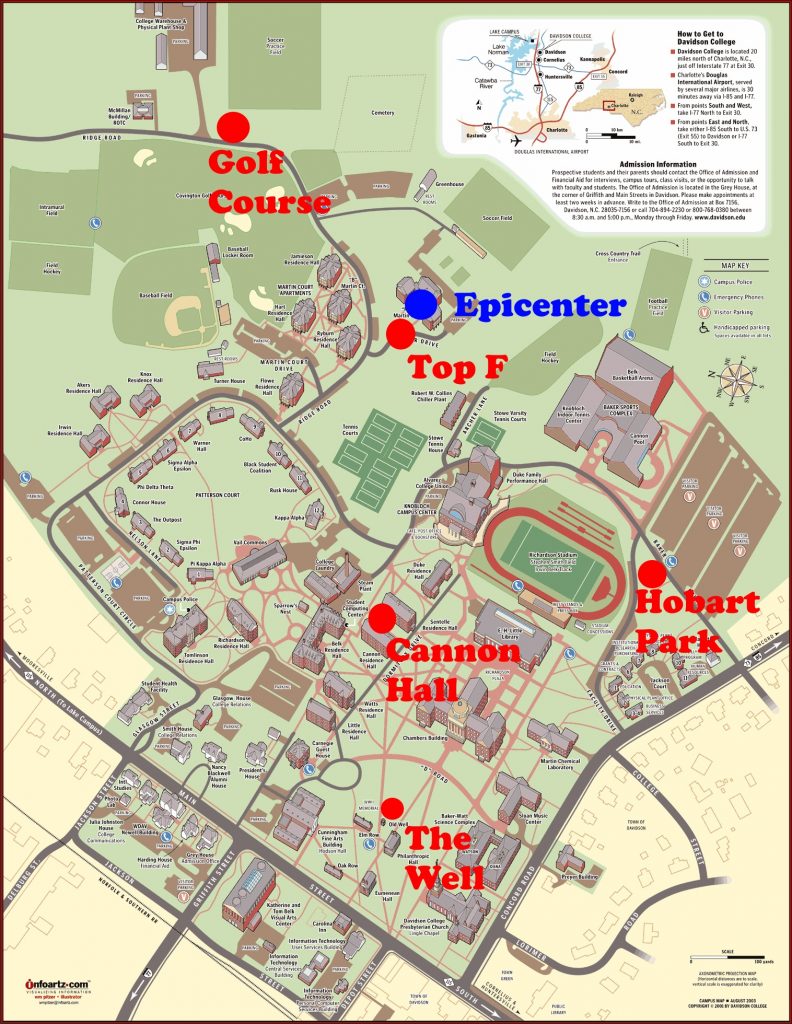
We fail to realize the world contains more than just what we can see. The world we live in is a grand soundscape, but we focus more on sights than sounds. A soundscape is a deeper illustration of our landscape. However, it is difficult to examine a soundscape when you do not know when to listen and what to exactly listen. It is easy to get caught up in personal affairs and school work as a college student, which causes us to not acknowledge our environment. We are so focused on other things that we do not notice the sounds around us. I have experienced that first hand while at Davidson because I have failed to acknowledge the sounds within my environment on a daily basis. For this project, I chose three areas outside that I venture to the most on campus in my spare time. Furthermore, I recorded my friends and myself skateboarding like on a normal trip to these areas. Skateboarding is a part of my life on campus, and I wanted to capture and analyze that soundscape since I normally do not exert attention to the sounds in my environment. My soundscape is unique because skateboarding is not prominent on Davidson’s campus which marginalizes my soundscape.
Soundscapes possess various aspects which makes it important to establish the definition of a soundscape. Places that people spend the majority of their time in are their daily soundscapes, but any environment can be a soundscape. On campus, I can view a classroom as a soundscape, the basketball court as a soundscape, and an outside environment as a soundscape. My friends and I enjoy skateboarding, so I tend to ride my skateboard everywhere when I finish my classes for the day. A soundscape includes any acoustic environment, though. According to Schafer, “A soundscape consists of events heard not the objects seen.” (Sterne, 99) So a soundscape is not just a visual setting nor a single setting. Soundscapes can interweave as you move throughout your environment. Schafer also asserts, “noise pollution results when man does not listen carefully.” We tend to choose and pay attention to the sounds that we only want to focus on which often causes noise pollution to be resisted by noise abatement. When you examine a soundscape, you should observe it in silence to focus on the auditory level instead of the visual. I recorded my friends and myself skateboarding in three areas on a daily basis. I was silent in my recordings in order to draw more attention to the auditory aspect of my environment.
The first recording displays my friend and me skating from the parking lot in front of the President’s house to our dorm. The video is only a segment of the venture because I stopped recording before we actually arrived at the dorm. We skate in the parking lot in front of the President’s house because it is the best surface to skate on that is closet to our dorm. In the video, we skate over two different surfaces. We started on the pavement in front of the President’s house then moved onto the brick and then back onto the pavement in the parking lot in front of our dorm. In the video, you can notice the difference between the sounds of the two surfaces. The friction between the pavement and rolling skateboard wheels are the cause of the sound. Skating in front of the President’s house you can hear the friction is a little rough but steady. However, there is a clapping sound when we skate over the brick which is a very loud, disrupting sound. After we skate back onto the pavement, there is a noticeable difference between that pavement and the pavement we started on. This pavement has a deeper tone than the previous meaning that is a lot rougher. Schafer mentions soundmarks as a feature of soundscapes. A soundmark is a sound that sticks out from the environment, calling attention to itself. The clapping sound the skateboard makes rolling over brick is a soundmark because that is an identifier of skateboarding. When other people hear the clapping over bricks as in the video, they associate that with people riding skateboards.
The second recording is a segment of the daily trip from Alvarez Union to our dorm. We tend to ride pass a lot of people who are walking on this trip because Union is where the majority of people spend their time whether it be for food or to study. There are two major sounds in this recording: the lawnmower and the skateboards. The lawnmower makes a “vroom” sound which is very loud at the beginning of the recording, but it drowns out as we as skate further away. However, the clapping sound that the skateboard makes rolling over the brick shows exactly how disruptive it is. The clapping sound still manages to be heard over the loud “vroom” of the lawnmower. Notice in this recording that none of the people who we pass talk to us. It is also important to notice how one person was wearing headphones. Even though I encounter other people in my soundscape, their soundscape and my soundscape are different because of noise. Schafer asserts, “noises are the sounds we have learned to ignore.” (Sterne, 96) The person wearing headphones is a prime example. He is wearing the headphones for a particular reason: to rid of the noise in his soundscape. The sounds he does not want in his soundscape is the “vroom” of the lawnmower and the clapping sound of the skateboard rolling over the brick. However, my soundscape constantly consists of the clapping sound and for it to be seen as noise demonstrates how my soundscape is marginalized.
The third recording is my friends and me skating down a hill by the Baker Sports Complex. The complex is where we play basketball. It is far from our dorm, but we make the trip more enjoying and shorter by riding our skateboards to the complex. Skating near the complex is one of my more favorable locations because there is a smooth surface to ride on. The two main sounds in the recording are the wind blowing and the wheels rolling against the pavement. Both sounds are things I enjoy hearing in my soundscape. However, the sound of the wheels masks the sounds of the wind blowing, but you can hear the waves of wind brushing past when I point the camera down toward my board. The smooth surface is hard to find on campus because the majority of the pathways are composed of brick. Paying close attention to the sound of wheels rolling against the pavement makes me realize how much I appreciate skating on smooth surfaces which does not happen often.
Skateboarding is an uncommon form of activity on Davidson’s campus. My skateboard marginalizes my soundscape as other people label me which creates another identity of myself in other peoples’ soundscapes. Different aspects of my recording display that perception. Schafer states, “From society we will learn how man behaves with sounds and how sounds affect and change his behavior.” (Sterne, 96) There was one encounter with a campus police officer where my friends and I were standing with around with our skateboards. The officer asked if we attended Davidson, and he asked if we were just riding because no tricks are allowed. This occurrence displays how the sounds of my skateboard affect the people in my environment. Some people view the sound of my skateboard as noise, and a common way they attempt to ignore the noise is wearing headphones. It also presents that Davidson campus is not as open to the sounds my skateboard produces. This project can answer one of Schafer’s questions: which sounds do we want to preserve, multiply, encourage? I possess a different soundscape than most of the other students on campus. In my soundscape, I enjoy the sound of the friction between the pavement and my skateboard wheels which is why I skate everywhere to increase those sounds. However, other students view the entire campus as their soundscape and may not want to hear similar sounds as me. People may want more or less sounds in their soundscapes based on their interests.
Bibliography
Schafer, R Murray. “The Soundscape.” The Sound Studies Reader, ed. Jonathan Sterne, Routledge, 2012, pp. 95–103.